Shams Ur Rehman Alavi
editor@asiantribune.net
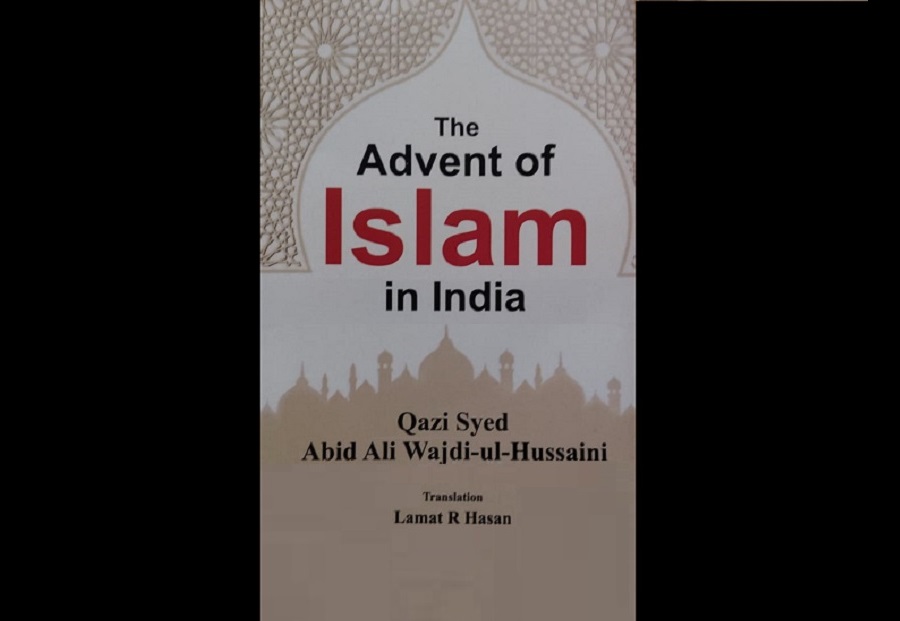
The Advent of Islam in India is an important book that covers centuries–the long period of history that starts from the arrival of Islam in India through Arab merchants on the coast of Kerala to the medieval era and subsequently the modern age.
The fact that after the British arrived in India, the story of Islam has mostly been viewed through a narrow lens–conquests and conflicts, while ignoring the fact that India had maritime trade ties with Arabia, long before Sindh was conquered.
This book uncovers how British-era historians sowed the seeds of communal discord to strengthen a particular perception and spread prejudices.
Late Qazi Syed Abid Ali Wajdi Ul Hussaini (1918-1990) had authored this book in Urdu and senior journalist Lamat R Hasan has finally translated it from Urdu to English. Qazi Wajdi Ul Hussaini was a renowned personality, a scholar and freedom fighter, apart from being a prolific author.
The book was first published in 1982. It explores the intersections of world and Islamic history and the canvas of the book is such that it traces the history of ancient Arab seafarers, their connections with India and the introduction of Islam in India over 1400 years ago.
“The role of English historians in framing Islam solely as a religion of military invasion and claiming that Muslims arrived in the subcontinent as late as eighth century is exposed”, writes Lamat R Hasan in her initial note.
She says that the book was written almost 45 years ago and readers may find the text eerily prophetic, especially, as the author himself urged future historians to carry out objective research and overturn the colonial narrative to preserve India’s syncretic culture. This book is divided in three parts.
The first part has chapters about the man of early human civilization, the invention of art of writing, Babylon, a psychological study of religion, the different religions–from sun worship to the Egyptian society, about other ancient civilizations and the rise of Islam.
One important factor about the book is that the author had devoted a chapter on the ‘mojza-e-shaqqul-qamar’ or the ‘miracle of the splitting of moon’.
In the second part of the book, Qazi Wajdi Ul Hussaini focuses on India, Dravidians, the shrine of Prophet Sheeth, India during the era of Prophet Muhammad and Islam in Malabar that is now part of Kerala state.
The book deals with Raja Sameri and the historical evidence of his conversion to Islam, apart from chapters on Hasan al-Basri, the arrival of the Taabi’in, Serendip, Coromandel Coast, Gujarat and the translation of Holy Quran in India.
There are chapters on religious figures, major personalities, Sufis, political climate of different eras, the arrival of Islam in Malwa region of Central India, Raja Bhoj and his period, other than Maharaja Moti Singh’s acceptance of Islam. The third part of the book has detailed discussion on perspectives about the ‘Miracle of Moon splitting’.
The book was originally published as ‘Hindustan Islam ke Saaye mein’. Lamat R Hasan has painstakingly translated this book that deals with multiple aspects that are important regarding history of Islam in India and also touches the early era of Muslims’ arrival in different regions of India, particularly, the central region–Madhya Pradesh.