By Huneza Khan
The Asian Tribune
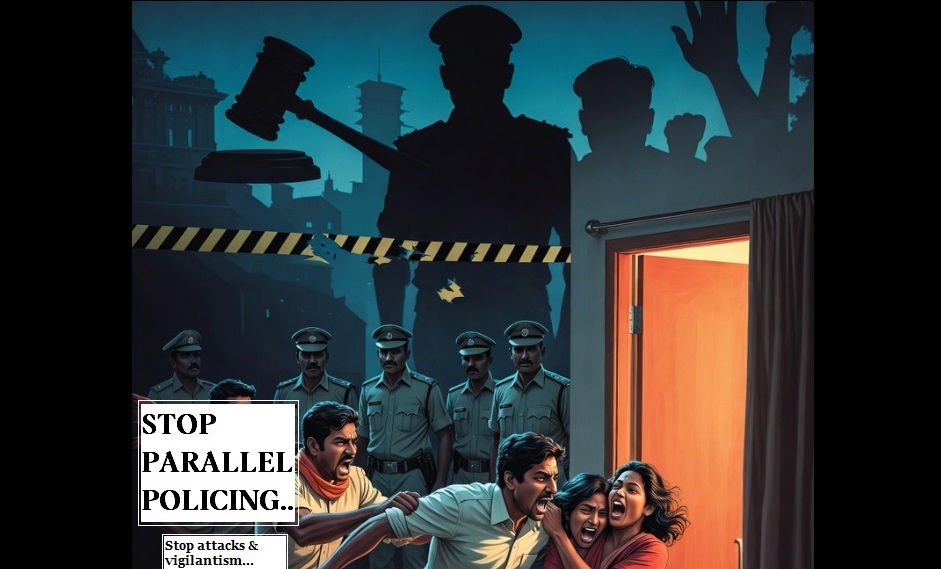
Indian Muslims woke up to disturbing videos from Bhopal last week (May 11), wherein self-styled vigilantes associated with the right-wing Hindu extremist group Bajrang Dal barged into a private hotel room occupied by a young interfaith couple. The footage that followed was brutal.
A 27-year-old Muslim man, Mohammad Arif, was publicly assaulted, stripped half-naked, humiliated, forced to consume cow dung, and made to chant ‘Jai Shri Ram’ in police presence. His offence was not violence or coercion but a consensual relationship with a Hindu woman.
Reports suggest that Arif and his partner were consenting adults who had been together for several years. None of that really mattered to the vigilantes, invoking the now-familiar ‘Love Jihad’ conspiracy theory. Arif’s Muslim identity alone was enough to convert a private relationship into a public spectacle of punishment.
The assailants violated the young man’s dignity and also made derogatory remarks about his God, Allah. The developments after the assault should unsettle— sicken us all. The usually calmer city of Bhopal reacted.
Public outrage emerged as protestors gathered in larger numbers, visibly angry. Yet the Muslim mobilization appeared not to be centred around the assault on Mohammad Arif, but the blasphemous remarks made against Allah during the attack. Every community has the right to protest speech or conduct it considers offensive to its faith.
Numerous responded accordingly as their religious sentiments were wounded. A citizen had been assaulted, degraded, and targeted because he was Muslim, and this central issue slipped away somewhere amidst the outrage. Community members during the protests distanced themselves from him because his relationship was viewed as religiously impermissible.
The victim’s personal morality complicated solidarity with him; that’s where the red buzzer alarms. Wrong about what exactly needs to be asked plainly: On what parameter was he wrong in the world where courts have repeatedly affirmed that two consenting adults have the right to live together with dignity. Mohammad Arif was not assaulted because vigilantes conducted a theological inquiry into whether he was a practising Muslim.
They did not ask whether he prayed five times a day, observed religious obligations, or lived according to Islamic principles. He was assaulted because he was identified as Muslim, which was sufficient to make him a target. Unfortunately, sections of his own community appeared more willing to judge him than defend him.
In doing so, they inadvertently legitimised the same dangerous logic that sustains vigilante politics: that empathy and solidarity must depend on the perceived morality of the victim. The Indian Constitution does not authorise mobs to punish consenting adults for their personal relationships. It does not permit vigilante groups to invade private spaces, publicly humiliate citizens, or enforce majoritarian morality through violence.
Whether one personally approves of live-in relationships or interfaith relationships is legally irrelevant. The question before society is not whether Arif’s relationship satisfied someone’s moral standards. The question is whether constitutional rights can survive if mobs are allowed to decide which relationships are acceptable. The distinction matters. How does piety become the benchmark of whether an individual, a victim, deserves protection from assault?
Constitutional protections begin to weaken for everyone once violence becomes morally negotiable. The danger of vigilantism lies precisely in its ability to shift public attention away from legality and towards the personal conduct of the victim. The mob has already succeeded in reframing the debate, the moment society begins asking whether the victim was ‘right’ before condemning the brutality against him.
This pattern is no longer an exception in India’s communal climate, where victims are frequently subjected to post-facto moral scrutiny. Citizens assaulted over allegations of cattle smuggling, interfaith relationships, or religious suspicion are rarely granted immediate human sympathy without conditions attached. Their private lives, beliefs, and choices are placed on trial even before the violence against them is fully acknowledged.
Mohammad Akhlaq, Tabrez Ansari, Pehlu Khan, Junaid Khan, Roshan Khatoon— these are painfully similar names, a long list. When Akhlaq was lynched in Dadri over cow slaughter allegations, and Tabrez Ansari was beaten to death in Jharkhand over theft allegations, did the community verify their prayer schedule before mourning them and demanding justice?
Of course not, because it would be absurd. The violence didn’t come because they failed some test of Islamic piety. It came because they were Muslim. The mob doesn’t care about faith credentials. It sees identity. The outrage over blasphemous remarks in the Mohammad Arif case was immediately visible but appeared conditional on the assault.
The victim’s suffering became secondary to debates over whether he had lived according to accepted religious norms. Consequently, creating a dangerous hierarchy of empathy where dignity depends on moral approval. A constitutional democracy cannot function on selective solidarity. Rights do not exist only for those who satisfy social or religious expectations.
In fact, constitutional morality becomes most important precisely when society disapproves of an individual’s choices. If public defence of civil liberties depends on personal piety or moral conformity, then rights themselves become conditional privileges rather than guarantees. There is also a deeper social crisis emerging here, particularly for Muslim youth.
Outside the community, they confront suspicion, communal profiling, and vigilante hostility fuelled by conspiracy theories like ‘Love Jihad’. They fear moral abandonment inside the community if their personal lives fail accepted standards of conduct. They are trapped in an alienating condition between external hostility and internal judgment: the feeling that one may be defended neither as a citizen nor fully accepted as a community member.
The message is unambiguous: the mob has our blessing if your conduct is unacceptable— a betrayal dressed up as a principle, making it easier for violence to flourish. Because that’s what the vigilante learns from Bhopal: the community will abandon bad Muslims.
This does not mean religious values are unimportant, nor does it mean communities cannot debate morality within their own social spaces. However, there is a difference between moral disagreement and withholding solidarity from someone facing public humiliation and violence. A society committed to constitutional principles must be able to defend a citizen’s dignity even when it disagrees with his choices.
The most sinister aspect of the Bhopal incident is not merely that vigilantes felt empowered to brutalise a man publicly. It is that the conversation after the violence became fragmented between religious outrage, moral judgment, and communal positioning, while the central constitutional issue was overshadowed altogether. A citizen was assaulted in public because of his identity. That alone should have provoked unequivocal concern.
The real test of a democracy is not how it treats ideal citizens. It is how firmly it protects the dignity and rights of those whom society may personally disapprove of. Once solidarity becomes conditional upon moral perfection, the distance between constitutional order and mob rule begins to narrow dangerously.
Until we answer the question Who will shelter them?—really answer it, unconditionally, without a purity test—we are complicit in what comes next.
[Huneza Khan is a Bhopal-based journalist. She has been writing on crime, law-and-order, society and a wide range of issues.]