The Asian Tribune
www.asiantribune.net
India has long staked its future on the potential of its young population, the world’s largest cohort of school-age children. Yet for millions of families, the education system remains a landscape of profound contradiction: ambitious policy on one hand and a daily struggle for access, quality, and intellectual integrity on the other.
This crisis is especially urgent because it is not merely administrative. It is financial, structural, political, and deeply ideological.
India’s school education system is mainly administered by a three-tiered government structure—central, state, and local, alongside a large and expanding private sector.
As per Indian Constitution and the 2009 Right of Children to Free and Compulsory Education Act, education is a fundamental right for children aged 6 to 14, offering free and compulsory access. The country has over a million schools, with a ratio of roughly 10 public schools to 3 private schools. However, enrollment numbers alone obscure a deeper issue regarding the quality of learning.
The National Education Policy (NEP) 2020 aimed to overhaul India’s education with a 5+3+3+4 model, promote mother tongue instruction, and universal foundational skills by 2025. The 2025–26 budget allocated ₹1,28,650 crore, a 6.22% increase, of which ₹78,572 crore was for schools (one crore equals ten million).
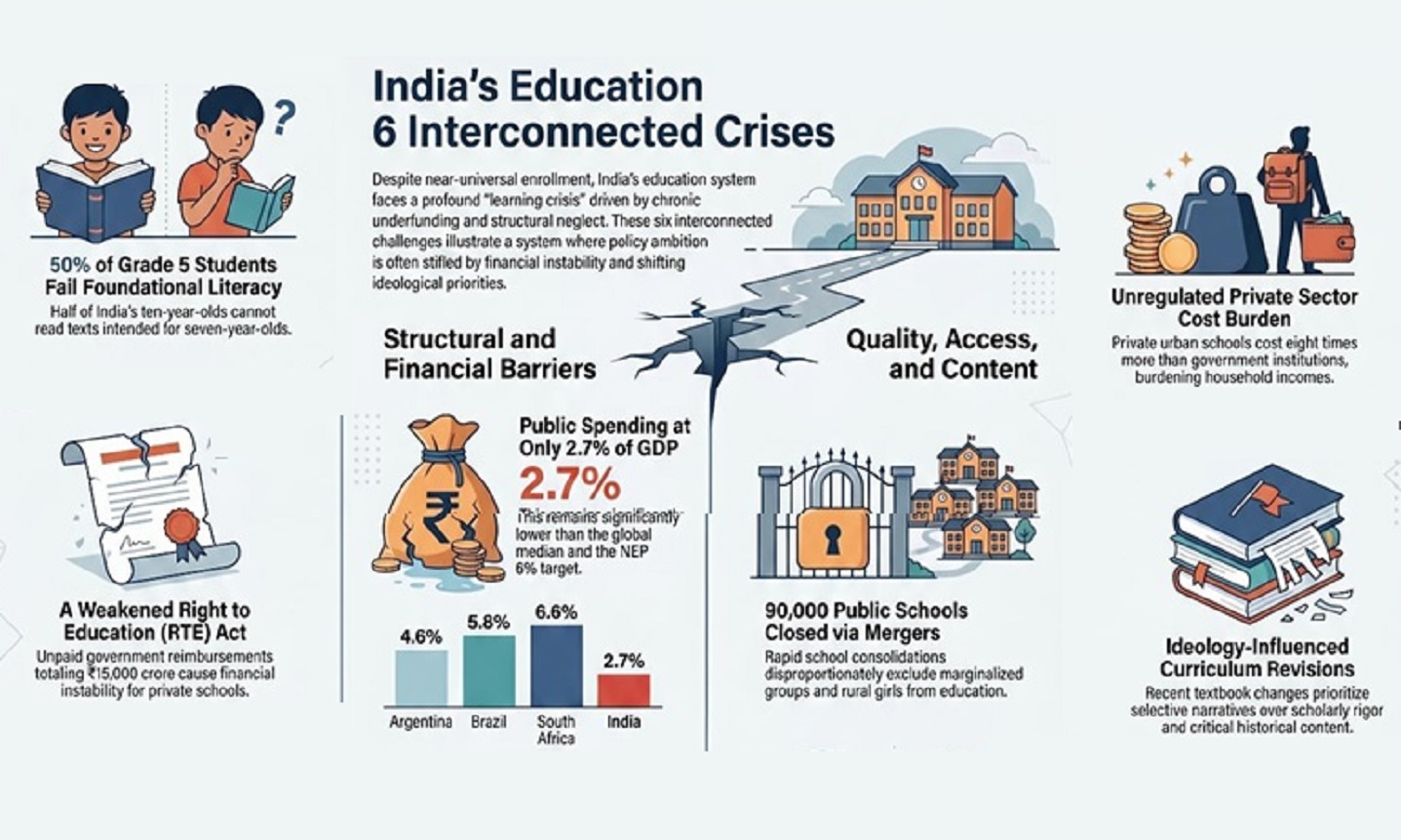
Yet, India’s public education spending was only 2.7% of GDP in 2023–24, among the lowest globally, contrasted with countries like Brazil (5.8%), South Africa (6.6%), and Argentina (4.6%), with a global median of 4%. NEP 2020 targets 6%, which India has never achieved. Despite higher household and public spending, the gap between commitment and private burden remains a problem.
The Learning Crisis
Despite near-universal school enrolment, ASER 2024 reports over 98% enrolment for children aged 6–14 in rural India, what happens inside classrooms is sobering. Only 50% of Grade 5 students can read a Grade 2-level text, a figure that has barely shifted from 47% in 2018, according to Pratham’s Annual Status of Education Report (ASER) 2024.
Just 45% can solve simple division problems. In effect, half of India’s ten-year-olds are functionally illiterate by the standards expected of seven-year-olds. India’s standing on international benchmarks reinforces this alarm. The last time India participated in the PISA (Programme for International Student Assessment) tests, in 2009, it ranked 72nd out of 73 countries, second from the bottom.
The government has since declined to participate in PISA 2014 and 2018, and withdrew at the last minute from the 2022 cycle, amid concerns that poor results ahead of the 2024 general elections could be politically damaging. India’s own National Achievement Survey (NAS) 2021 found average scores below 50% across subjects, confirming that the learning crisis is systemic, not incidental.
This is not merely a rural problem. It reflects a public education system where the national pupil-teacher ratio averages 35:1, well above the mandated 30:1, teacher vacancies exceed one million nationwide, and teacher absenteeism remains structurally unaddressed. In rural government schools, inadequate infrastructure and poor digital connectivity further compound the challenge.
Uttar Pradesh, India’s most populous state, shows systemic decline with female literacy at only 57.18%. In mid-2025, the Basic Education Department started merging over 10,000 schools due to low enrollment, closing or consolidating those with fewer than 50 students. UDISE+ data reveals a drop in government schools from 11,07,118 in 2014–15 to 10,17,660 in 2023–24, about 90,000 fewer over ten years, while private schools grew by over 42,000. Critics, including teachers’ unions, opposition parties, and child rights activists, see this as neglect, not optimisation.
For rural marginalised communities, neighbourhood schools are often the only option, but longer travel hampers attendance, especially for girls. The Allahabad High Court upheld the government’s stance despite protests. Similar consolidations in Madhya Pradesh, Jharkhand, and Odisha indicate a national policy.
A growing concern among educators and policymakers is the alignment of school curricula with perspectives beyond the purely academic. Recent revisions to national textbooks across multiple subjects and grade levels have omitted or reframed significant historical, social, and constitutional content. Critics, including prominent historians and legal observers, argue that these changes prioritise selective narratives over scholarly rigour.
A 2024 judicial intervention called for greater transparency in the curriculum review process. When foundational documents and contested historical episodes disappear from classrooms without pedagogical justification, the long-term effects on students’ critical thinking, civic understanding, and engagement with their own history warrant serious, non-partisan scrutiny.
The Cost Burden of Private Education
The increasing popularity of private schools, now constituting 29% of enrollments among 6–14-year-olds, is partly due to families moving away from declining public schools. However, this shift comes with a significantly higher and less transparent cost.
The MoSPI CMS-E 2024–25 survey shows that a private unaided school in urban India typically costs eight times as much as a government institution. Mid-tier private schools in Tier-1 cities charge between ₹1.3 and ₹2.8 lakh annually, while high-end international schools can ask for ₹3 to ₹7.5 lakh. Additionally, initial admission fees in metro areas can reach up to ₹2 lakh.
A Schoolnet survey found that parents spend 20–30% of household income on education, covering tuition, transport, books, exam fees, and optional charges. A Bengaluru parent said that activities like painting, pottery, and swimming, once included in fees, are now charged separately, excluding children if parents decline to pay.
An income of ₹20–25 lakh is now the threshold for accessing private schools. Fee regulation is inconsistent: Delhi capped annual hikes at 15% in 2025, while Tamil Nadu’s judicial model faces legal challenges. Urban families spend ₹2,791 less annually on girls’ education than boys.
The RTE Act
The 2009 RTE Act made education a legal right in India, requiring private schools to reserve 25% of seats for EWS children, with the government reimbursing costs.
However, flaws in design and execution have led to unpaid reimbursements totaling ₹15,000 crore since 2014, with compliance remaining inconsistent even after the 2023 Delhi High Court ruling. Many private schools face financial instability, especially smaller, non-profit ones, due to legal exemptions such as the 2014 Supreme Court ruling that excluded minority institutions from the quota.
Wealthy parents sometimes obtain fake EWS certificates, displacing genuinely disadvantaged children. Despite laws deeming school education not-for-profit, cash donations and fees dominate urban India, creating a dual fee system that burdens families and benefits the connected.
The Road Ahead
India faces multiple interconnected challenges in education. These include a chronically underfunded public system, an RTE Act weakened by non-reimbursement and legal exemptions, a private sector thriving in an unregulated grey economy, the exclusion of marginalised groups through school mergers, poor learning outcomes, and a curriculum that prioritises political interests over national ones, each a crisis in its own right.
Collectively, they signal a failure across generations. NEP 2020 aims to transform the education system into an inclusive, intellectually rigorous one.
Its success will be measured not just by budget figures or enrolment rates, but by tangible outcomes: whether a Grade 5 child in rural Uttar Pradesh can read, whether a girl from a marginalised community has a nearby school and whether private schools can operate without cash-in-envelope payments.
Or whether Indian students will learn correct history instead of curated stories. The gap between India’s current state and its educational goals is more than administrative; it hinges on political commitment and national conscience.