By Sabir Ahamed
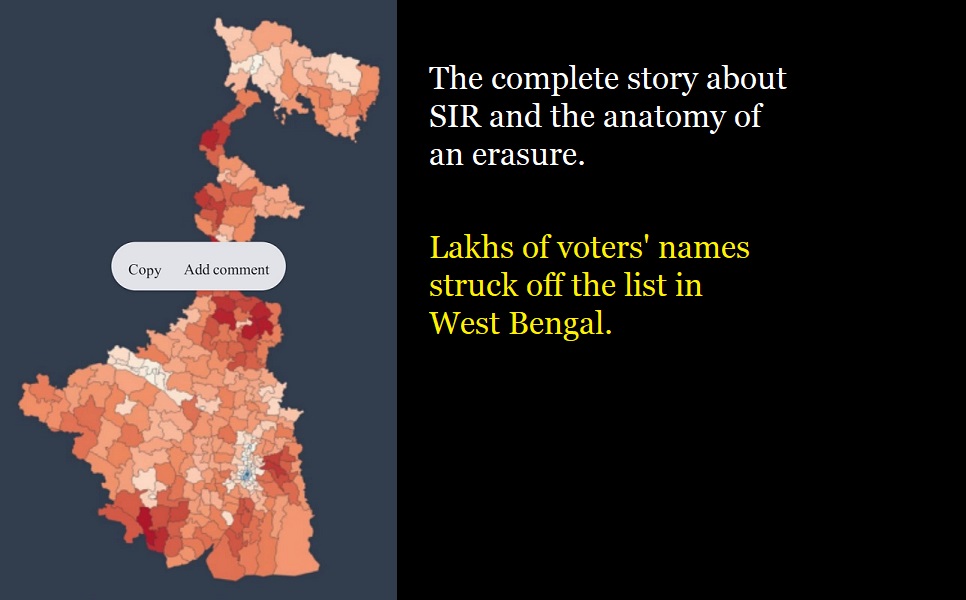
A veteran journalist, a student pursuing a PhD at an IIT, or a peasant in rural West Bengal—each of them having multiple identity documents, acquired a unique identity of a ‘deleted voter’.
Socially and economically, they belong to very different groups, yet they are united by a common ordeal. A journalist missed his daughter’s wedding. Students are struggling to secure admission because their OBC certificates are now linked to the SIR process. And these are only a few examples.
There seems to be no end to the everyday hardships faced by citizens affected by SIR. Behind every deleted name is a person, a family, and a life disrupted.
Between 2002 and 2004, the Election Commission of India (ECI) conducted the country’s last full round of Special Intensive Revisions of electoral rolls. Officers went door to door. Names were added. Duplicates were removed. The dead were struck off. The rolls were reprinted. It was slow, imperfect and human. It was, above all, bureaucratic.
The exercise had a long lineage. Since 1952, intensive revisions had been carried out in 1952 to 56, 1957, 1961, 1965, 1966, 1983 to 84, 1987 to 89, 1992, 1993, 1995, 2002, 2003 and 2004. In every earlier iteration, the purpose was correction. The politics around it was mild. The paperwork was tedious. The outcome was a cleaner list.
The Special Intensive Revision that unfolded in West Bengal between December 2025 and February 2026 was of a different species. It carried the same acronym. Its architecture was unrecognisable. Roughly 7.66 crore voters were on the state’s rolls when the process began. By the time the final list was published on 28 February 2026, around 58 lakh names had been marked as Absent, Shifted, Dead or Duplicate (ASDD), another 60 lakh plus were placed “Under Adjudication” in a category of legal limbo. Total deletions crossed 91 lakh, according to data compiled by the Sabar Institute from the ECI’s own PDFs.
Ninety one lakh is not a rounding error. It is nearly three times the 32.11 lakh vote margin by which the Bharatiya Janata Party (BJP) later swept the 2026 Assembly election. This essay reconstructs, using booth level, constituency level and demographic data, how the SIR of 2025 to 26 stopped being an audit of the electoral roll and started functioning as an instrument of targeted exclusion. Drawing from the data sources form ECI, we have curated a user-friendly data repository for the public.
Why the ECI was in Haste ? How Three Months Compressed Two Years of Work
The SIR in West Bengal was formally launched in November 2025. What followed was one of the fastest, largest and most contested electoral roll revisions in Indian history. Given the sheer population size, diversity in languages, such kind of exercise entails a rigorous ground work.
November 2025: SIR announced. Booth Level Officers (BLOs) begin door to door verification.
December 2025: First tranche of 58 lakh names deleted as Absent, Shifted, Dead or Duplicate (ASDD).
16 December 2025: Draft voter list published for West Bengal.
19 December 2025: The ECI decides to deploy roughly 3,000 to 3,500 Central government officers as micro observers, mostly drawn from Group B ranks in Central ministries, Central PSUs and public sector banks.
Late December 2025 to January 2026: The category “Logical Discrepancy” is introduced through algorithmic flags on ERONET, the ECI’s internal software. Approximately 1.25 to 1.36 crore voters [1] are marked in this new bucket. Hearings begin.
4 February 2026: The Supreme Court begins hearing Mamata Banerjee’s petition challenging the SIR. The Chief Minister alleges that micro observers had been appointed from BJP ruled states and had superseded the powers of the Electoral Registration Officers and Booth Level Officers.
9 February 2026: The Supreme Court extends the SIR deadline by a week and clarifies that final orders on claims and objections can be passed only by Electoral Registration Officers. Micro observers can only assist them.
20 February 2026: The Court invokes Article 142 to deploy judicial officers, requisitioning personnel from Jharkhand and Odisha to manage the backlog.
28 February 2026: Final electoral roll published. Over 60 lakh voters carry the “Under Adjudication” watermark on their listings.
March to April 2026: Supplementary lists issued. A further 27 lakh deletions are reported. Approximately 13 lakh names remain unrestored.
By the time the model code of conduct kicked in and polling day arrived, an electoral machinery that had traditionally taken 18 to 24 months to conduct an SIR had, in West Bengal, executed the entire exercise in just under three months.
The Wall of Data: How the ECI Published Information That Could Not Be Read
To understand the West Bengal SIR, one must first understand what the Election Commission chose to publish and what it chose to withhold.
The final electoral rolls were uploaded to the ECI’s public portal. On paper, this was transparency. In practice, it was a wall.
Alt News, which digitised the Bhabanipur (AC 159) and Ballygunge (AC 161) rolls, documented three concurrent barriers.
Barrier one: access. Bhabanipur alone contains 267 booths. The ECI portal permitted downloads for only ten booth areas at a time, each gated by a CAPTCHA. Automation was effectively blocked. The reporters recorded instances of the portal throwing an “invalid captcha” message even after the correct string had been entered. For Bhabanipur and Ballygunge together, 558 PDFs had to be downloaded by hand.
Barrier two: format. The rolls were not published as CSV, JSON, or any machine readable format. They were published as scanned image PDFs, effectively photographs of printed pages. These files were on average 228 times larger than a digitally readable equivalent, yet contained none of the underlying structured data. India runs Aadhaar, UPI and DigiLocker at scale. Publishing a machine readable file alongside a PDF is trivial. The absence was a choice.
Barrier three: the watermark. Roughly one in ten voter entries in the final roll carried a diagonal “UNDER ADJUDICATION” stamp printed across the record. On many entries, the watermark ran over the voter’s name itself, degrading both automated extraction and manual reading.
The Sabar Institute, working on a statewide scale, downloaded approximately 9,000 PDFs per Assembly Constituency, amounting to more than 26 lakh PDFs across all 294 constituencies. Only after weeks of processing were 91 lakh elector records converted into a machine readable dataset. The Institute recorded that the work was done on three crowd funded laptops.
The asymmetry is worth stating plainly. The ECI itself holds this data in structured form on its ERONET system. What was withheld was not information. What was withheld was usability.
Any reading of the West Bengal SIR that skips the categories will miss the story. The exercise sorted every one of the state’s roughly 7.66 crore voters into one of five administrative buckets. Two of them were about missing paperwork. One of them was not. That one carried the exclusion.
Mapping and the Unmapped
The first move of the SIR was mapping. The ECI required every voter, or a close relative of every voter, to establish a link to the 2002 electoral roll, which was the baseline of the last full intensive revision. This could be done two ways. Self mapping, where the voter’s own name and details appeared on the 2002 roll. Or progeny mapping, where the voter linked upward through a parent, grandparent or other named ancestor whose entry was in the 2002 roll.
Voters who successfully mapped were largely done. The 2002 registration was treated as presumptive proof of eligibility. No further documents were required.
Voters who could not map were tagged Unmapped. This is a specific category. It does not mean the voter was ineligible. It means the voter could not produce evidence of a documentary trail leading back to a 2002 registration in their family. Migrant urban populations, families displaced through the intervening two decades, communities where the 2002 exercise was patchy along with voters whose ancestral records did not survive were caught here. Roughly 31.38 lakh voters were placed in the Unmapped bucket in West Bengal.
Unmapped voters were sent hearing notices. They had to appear before Electoral Registration Officers with documents to establish their eligibility from scratch.
Absent, Shifted, Dead or Duplicate (ASDD)
Running parallel to mapping was a second stream, based on Booth Level Officer field verification. Voters who could be physically confirmed as absent from the address on record, shifted elsewhere, deceased or duplicated on another entry were tagged ASDD. This category was created for outright deletion. No hearing. No mapping.
Approximately 58 lakh names were deleted under ASDD in the December 2025 draft roll.
Both Unmapped and ASDD had, at least, a coherent administrative logic. ASDD deletions were for voters who could not be found at their listed address, for good reason or bad. Unmapped voters were those who could not connect to a prior register. In both cases the underlying issue was documentation. The voter either was not there or could not prove they were.
Logical Discrepancy
The third category is the one that has no equivalent in any earlier Indian intensive revision.
Logical Discrepancy applied to voters who had successfully mapped to the 2002 roll. In other words, they had passed the very test that was meant to keep them eligible without further scrutiny. They were then flagged anyway, on the basis of internal inconsistencies in the ECI’s ERONET software output.
The flags, as later summarised by the Supreme Court and the ECI itself, included a mismatch in the parent’s name, an age difference between voter and parent of less than 15 years or more than 50 years, a difference in grandparents’ ages of less than 40 years and cases with more than six progenies linked to one voter [5]. To this list the software added spelling variations, transliteration mismatches and gender field anomalies.
None of these flags relate to the voter’s own identity, address, age or eligibility to vote. They are inconsistencies in the metadata around the voter. A parent’s age. A sibling count. A transliteration of a family name.
Roughly 1.25 crore to 1.36 crore voters were placed in this bucket at peak. Later filtering brought the working figure down to around 80 lakh to 95 lakh, then to the roughly 60 lakh who remained “Under Adjudication” when the final roll was published.
Under Adjudication
Under Adjudication was not a deletion. It was a suspended franchise. Voters in this pool were sent hearing notices. They had to appear before Electoral Registration Officers or, later, before Supreme Court deputed judicial officers. Their task was to produce documents to resolve whatever inconsistency the ERONET algorithm had flagged.
The final electoral roll published on 28 February 2026 carried a diagonal “UNDER ADJUDICATION” watermark across the entries of 60,06,675 voters. They remained on the roll. They were not allowed to vote.
Supplementary Lists
Post final roll, the ECI issued supplementary lists to publish the outcomes of continuing adjudication. Cleared voters could be restored. Uncleared voters could be deleted. Sabar Institute’s dataset shows that from the roughly 60 lakh Under Adjudication pool that flowed through this stage, approximately 27 lakh voters were ultimately deleted through the supplementary lists in March and April 2026.
Which is to say. A quarter of the voters who were placed under adjudication for what the algorithm called a “logical discrepancy” ended up disenfranchised. Not because they lacked documents. Not because they failed to prove their identity. They lacked, in most cases, the ability to defend a mismatch that never should have been the issue.
The Invention of “Logical Discrepancy”: A Filter Without a Manual
Every SIR of the last seventy years sorted voters into two broad groups. Names that could be linked to the previous roll. Names that could not. The West Bengal SIR of 2025 to 26 introduced a third bucket. That third bucket did the heaviest lifting.
The Logical Discrepancy category was, on the record, an ECI innovation for West Bengal. The Wire’s investigation into the varying rules the Election Commission applied across states confirmed that this category emerged during West Bengal’s SIR and had not been prominent during the Bihar exercise [6] which had immediately preceded it.
The Election Commission’s own SIR manual, dating to the 2003 to 2004 cycle, contains no such category. The 2025 Bihar SIR, which had been conducted between June and September 2025 as the template for a nationwide revision, sorted voters into Mapped and Unmapped only. There was no third bucket. There was no algorithmic re flagging of already mapped voters. The 27 lakh disenfranchisements that flowed through Logical Discrepancy in West Bengal had no equivalent in Bihar.
The National Herald asked the operational question that has still not been answered publicly. Which agency designed the algorithm that produced the 1.25 crore Logical Discrepancy flags. When the ECI had introduced the Bihar SIR, it had claimed that a commissioned study had flagged anomalies in the electoral rolls, but the identity of the agency conducting that study and its methodology have not been made public [7]. For West Bengal, not even that much was placed before the Court.
The Mirror Image: The Two Scatter Plots
The most damning finding in the Sabar Institute’s evidence is not a single number. It is the shape of two scatter plots when placed side by side.
The first plots the Muslim population share of each constituency against the Unmapped rate in that constituency. In this plot, the relationship is inverse. Constituencies with higher Muslim populations recorded lower Unmapped rates. In Malda, Murshidabad and border regions, less than 2 per cent of Muslim voters remained unmapped.
In the Matua belt of North 24 Parganas and Nadia, where Scheduled Caste and Matua communities dominate, unmapped rates ran as high as 14.3 per cent. Urban Kolkata, with its migrant populations, also saw significantly higher unmapped shares.
Put simply. Muslim majority constituencies did better at documentation than Hindu majority constituencies with marginalised populations.
The second plot inverts the first. It plots the Muslim population share against the Under Adjudication rate. In this plot, the relationship is direct. The same constituencies that recorded the highest mapping success now record the highest Under Adjudication share.
The two curves are mirror images. Where one falls, the other rises. And they meet only in the Muslim majority districts of Malda, Murshidabad and Uttar Dinajpur, where mapping was cleanest and adjudication caught the largest share of the electorate.
Unmapped population share versus estimated Muslim population across West Bengal Assembly Constituencies. Source: Sabar Institute. Under Adjudication share after the SIR final list versus estimated Muslim population across constituencies. Source: Sabar Institute.
Sujapur and Domkal, two of the most Muslim dominated Assembly Constituencies in West Bengal, sit at the extreme end of both plots.
In Sujapur, mapping succeeded for over 99 per cent of voters. Only 0.58 per cent were tagged Unmapped. ASDD deletions were within statewide norms. On the paperwork test, Sujapur passed.
Sujapur then recorded the highest Under Adjudication share in the state at 52.49 per cent. More than one in every two voters ended up in limbo, not because they lacked documents, not because they had shifted, not because they had died, but because an algorithm flagged a mismatch in a parent’s name, or a spelling variant of a surname, or a sibling count above six, or a mother whose recorded age of marriage produced a parent to child gap the software regarded as “logically” impossible.
Domkal fits the same profile. It has among the highest mapping success rates in the state. Its ASDD deletions are within normal bounds. Its female deletion share is one of the highest in West Bengal, at 65.4 per cent. Its Under Adjudication share is among the top brackets in the state.
There is a specific West Bengal reason why the parent to child age gap flag caught so many voters in these constituencies. West Bengal has, historically, one of the highest child marriage rates in India. NFHS 5, released in 2022, recorded that more than 41 per cent of women aged 20 to 24 in the state were married before the age of 18.
In the older cohort, whose electoral entries dominate the 2002 roll, the rate was even higher. When a current voter is 20 years old and their mother was married at 14 or 15, the mother to child age gap on the record will show up as less than 15 years.
The algorithm did not know it was flagging child marriage. It flagged the arithmetic anyway. And it flagged it, disproportionately, in the constituencies where the mapping had otherwise succeeded.
Unmapped and Under Adjudication shares in the top ten Muslim-majority seats. Source: Sabar Institute.
Alt News’s investigation of the Bhabanipur and Ballygunge rolls documented the mechanical failures of the algorithm in specific detail. Transliteration variations, “Mohammed” versus “Muhammad”, “Mondal” versus “Mandal”, “Ahmed” versus “Ahmad”, routinely confused the ERONET software. Poor quality scans of older rolls further undermined matching. A voter could be flagged not because they were ineligible. They could be flagged because the software failed to recognise what a human reader would have accepted at a glance.
The Reporters’ Collective, working in Uttar Pradesh alongside the SIR rollout there, went further. It documented that the second software layer, which verified mapping through “logical discrepancies”, operated without a written codified procedure that citizens could reference [8]. Voters could not appeal a specific rule. Officials could not explain in writing why a particular flag had triggered. The algorithm was proprietary. The exclusion was operational.
Midway through the West Bengal exercise, the ECI updated the algorithm. Voters who had already been successfully mapped were re flagged. The goalposts shifted in real time.
The Numbers Behind the Flag
The demographics of Under Adjudication tell the story more sharply than any narrative can.
Ballygunge (AC 161): Muslim share of population, approximately 50 per cent. Muslim share of the Logical Discrepancy list, 77.5 per cent.
Bhabanipur (AC 159): Muslim share of population, approximately 20 per cent. Muslim share of the Logical Discrepancy list, 51.8 per cent. Muslim share of Under Adjudication cases, 56.65 per cent. Combined with deletions, Muslims accounted for 49.45 per cent of all disputed entries in the Chief Minister’s own constituency.
Alt News, working with a religion classifier trained on Bengali naming conventions, found that across Bhabanipur and Ballygunge combined, a Muslim voter was 3.1 times more likely to have their name placed under adjudication than a Hindu voter. In Bhabanipur specifically, nearly one in four Muslim voters was placed under adjudication. Among Hindu voters in the same constituency, the ratio was fewer than one in seventeen.
The Sabar Institute finding is direct. The category “had no precedent in earlier SIR exercises conducted in other states and was introduced for the West Bengal SIR.”
Muslim share of the Logical Discrepancy list against the December 2025 exclusion list and estimated Muslim population, across four constituencies. Source: Sabar Institute.
The Public Display Order That Nobody Could Find
On 19 January 2026, the Supreme Court, hearing pleas alleging arbitrariness in the SIR, directed the Election Commission to publicly display the names of all voters on the Logical Discrepancy list at gram panchayat bhavans, block offices in every taluka and ward offices in the cities [5]. The Court’s reasoning was straightforward. If the Commission was going to place 1.25 crore voters in a suspended franchise, those voters were entitled to see the specific flag that had caught them. They were entitled to challenge it.
On 24 January 2026, the ECI briefly uploaded the Logical Discrepancy list on its portal, so that district electoral officers could download and display the list at panchayat bhavans and block offices, as the Court had directed.
That brief upload is, effectively, the last time this list was available in any browsable public form. The lists are not, as of the writing of this essay, accessible on the ECI’s website in searchable, machine readable or even scanned image format for public inspection. Journalists, researchers and affected voters seeking to verify the flags that produced 1.25 crore notices have had to reconstruct them from the physical displays that survived and from the samples that reached individual voters.
The exclusion happened through an algorithm nobody could examine, flagging voters against a rule set that was never in a manual, generating a list that was only briefly public, adjudicated in hearings that ran on compressed timelines, before officers many of whom, the Supreme Court eventually ruled, did not have the authority to decide anyway.
Who Actually Ran the SIR
For the first time in an intensive revision, the officers who ran the day to day work at booth and hearing level were largely not Bengal cadre.
The ECI appointed roughly 3,000 to 3,500 micro observers for West Bengal. These were Central government officials or officials from Central public sector undertakings and public sector banks, from Group B category or above.
Their formal mandate, per the ECI, was to check enumeration forms uploaded by BLOs, verify documents submitted by voters, observe hearing proceedings and assist Electoral Registration Officers and Special Roll Observers.
On 4 February 2026, Mamata Banerjee argued in the Supreme Court that micro observers had been appointed from BJP ruled states and had effectively superseded the powers of Electoral Registration Officers and Booth Level Officers. Her counsel Abhishek Manu Singhvi submitted that the ECI had deployed observers unfamiliar with the state’s language, culture and administrative conditions. According to Singhvi, these officers were effectively performing the role of BLOs.
The ECI’s response was that it had been compelled to appoint micro observers after the West Bengal state government failed to provide an adequate number of Class II officers [12]. On 7 February, the state told the Court it was ready to depute 8,555 Group B officers. On 9 February, the Court extended the SIR deadline by a week, directed the state to make the officers available and clarified that only Electoral Registration Officers could pass final orders on claims and objections. Micro observers could only assist them.
By then, the hearings had already been running for weeks.
An internal ECI report dated 20 February revealed how much of the initial work the micro observers had already done. 1,22,96,630 voters had been marked “Go to Next Elector” by micro observers, meaning they had been cleared. Another 2,63,374 had been cleared by roll observers. District Election Officers had verified the status of 1,37,07,063 voters.
Also documented by the National Herald in early January, the ECI itself had begun warning micro observers of stringent disciplinary action for any deliberate deviation from the prescribed standard operating procedures, following inputs that some observers were not adhering to guidelines while performing their duties.
The warning came before the newly appointed Special Roll Observers, four IAS officers from outside the state, took charge.
The point here is not that every micro observer acted maliciously. The point is structural. An exercise that had traditionally been run by locally rooted BLOs and district officers, was, in West Bengal, run at speed by imported Central staff, in a language many did not speak, at hearings the SC eventually said they were not authorised to decide anyway.
Reading the Deletions: What the Statewide Data Shows
The Sabar Institute’s core dataset covers all 294 Assembly Constituencies. Its findings, cross checked against Deccan Herald’s independent analysis and Alt News’s constituency level work, converge on the same pattern that Sections IV and V described in category and mechanism. This section presents the constituency level evidence in full.
For reference, the ten most Muslim dominated constituencies in West Bengal, with their Unmapped and Under Adjudication rates.
Constituency
Under Adjudication
Unmapped
Sujapur
52.49%
0.58%
Samserganj
45.92%
1.04%
Raghunathganj
45.88%
0.72%
Lalgola
41.32%
1.16%
Bhagabangola
40.25%
2.65%
Malatipur
40.06%
0.61%
Suti
39.36%
0.59%
Mothabari
39.33%
0.82%
Ratua
37.56%
0.61%
Farakka
37.05%
2.50%
Across all ten, the Under Adjudication share runs 15 to 90 times higher than the Unmapped share. The mapping worked. The adjudication did not.
Unmapped population share after the SIR in the Matua belt (left) and in Kolkata and adjacent constituencies (right). Source: Sabar Institute.
Assembly-Constituency-wise Under Adjudication count across West Bengal. Source: Sabar Institute.
The widest population versus deletion gaps
Among constituencies with at least 1,000 deletions, Sabar Institute identified those where the Muslim share of deletions exceeded the Muslim share of the population by the largest margin.
District
Muslim % of deletions
Muslim % of population
Gap
Patharpratima
South 24 Parganas
92.10%
9.10%
+83 pts
Phansidewa (ST)
Darjeeling
93.00%
14.20%
+79 pts
Moyna
Purba Medinipur
84.40%
9.20%
+75 pts
Maynaguri (SC)
Jalpaiguri
83.50%
9.10%
+74 pts
Pursurah
Hooghly
90.50%
16.40%
+74 pts
Nandigram
Purba Medinipur
94.50%
23.00%
+71 pts
Patharpratima, a Scheduled Caste and general mixed seat in South 24 Parganas where Muslims make up 9.1 per cent of the population, produced a deletion list where 92.1 per cent of the removed voters were Muslim. Nandigram, the seat of the then Leader of the Opposition Suvendu Adhikari, produced a deletion list where 94.5 per cent of the names were Muslim, in a constituency where Muslims form 23 per cent of the population
Population share, ASDD deletion share and share among supplementary-list deletions in Nandigram (left) and Bhabanipur (right). Source: Sabar Institute.
Booth level concentration.
The pattern was not diffuse. Sabar Institute recorded 1,850 individual booths where Muslim deletions ran at 99.5 per cent or higher, each with at least 100 records. In Samserganj (AC 56), several booths, including Part 106, Part 200 and Part 98, recorded 100 per cent Muslim deletions, each with 600 to 800 or more records.
Deletions of that magnitude, in booths of that size, at that consistency, are not the product of random administrative drift. They are the signature of a filter. Religious composition of deleted and Under Adjudication voters in the Bhabanipur final list. Source: Sabar Institute.
Most common surnames in Bhabanipur in the ASDD deletion list (left) and the Logical Discrepancy list (right). Source: Sabar Institute.
The Gender Dimension: Where the Filter Also Caught Women
Women accounted for 53.6 per cent of the 58 lakh ASDD deletions. In several rural constituencies, the female share climbed above 65 per cent. Keshiary, 65.6 per cent. Suti, 65.4 per cent. Domkal, 65.4 per cent. Hariharpara, 65.3 per cent. Mothabari, 65.2 per cent.
Four individual booths recorded 100 per cent female deletions. Amta Part 144 (48 of 48). Garbeta Part 245 (44 of 44). Domkal Part 261 (41 of 41). Suti Part 168 (37 of 37).
Garbeta (AC 233, Paschim Medinipur) recorded the highest female share of deletions among all constituencies, at 79.81 per cent. The reasons Sabar Institute recorded map cleanly onto the documentary demands of the SIR.
43.7 per cent of female deletions were logged under “Permanently Shifted”. In a state where marriage typically involves a woman moving to her husband’s household. In a state where documentation linking natal and marital addresses is often thin. The “Permanently Shifted” tag became a structural exit door.
16.5 per cent of female deletions were recorded under “Untraceable or Absent”.
This category drew heavily on educational certificates and property records. Only 41.8 per cent of women in West Bengal hold matriculation or secondary certificates, a lower share than men. Property records lean overwhelmingly male. When an SIR relies on such documents as the fallback for identity confirmation, the failure mode is gendered by construction.
Female voters deleted as a share of deletions across West Bengal Assembly Constituencies. Source: Sabar Institute.
Women removed as Permanently Shifted (left) and as Untraceable or Absent (right) across constituencies. Source: Sabar Institute.
Amid the numbers, some smaller communities disappeared with almost no public notice.
Kolkata’s Chinese Community. In Kasba, 304 voters of Chinese descent were removed. The majority were tagged “Permanently Shifted”. For a community whose historic Chinatown in Tiretta Bazaar and Tangra has shrunk over decades but retained a Kolkata voter base, the deletion functions as a small archive being closed.
Transgender Voters. Of 1,811 registered transgender voters in West Bengal, 250 were deleted as untraceable, approximately 14 per cent. Housing instability, early family separation and limited legacy documentation combine into a demographic that documentation heavy systems tend to lose. When the SIR asked for records that traced back to 2002, this community lost roughly one in seven of its registered voters at a stroke.
People of Chinese descent removed from the Kolkata rolls, by gender and locality. Source: Sabar Institute. Recorded reasons for deletion of voters of Chinese descent in Kolkata. Source: Sabar Institute.
When Deletions Exceed Margins: The Electoral Question
The most politically explosive finding is the simplest arithmetic.
Total SIR related deletions: approximately 91 lakh voters.
BJP’s statewide margin of victory over the TMC: 32.11 lakh votes.
The deletions were nearly three times the winning margin.
Ratios like this can be misleading if deletions are evenly spread.
In West Bengal, they were not. Sabar Institute and the Deccan Herald authors, working from the same underlying dataset, found:
In 161 of 293 Assembly seats (54.8 per cent), total deletions exceeded the margin of victory. The BJP won 105 of these seats. The TMC won 53.
In 124 seats (42.2 per cent), non death deletions alone exceeded the winning margin. In 50 seats (17 per cent), deletions from the supplementary list alone, meaning voters placed under adjudication and then removed, were greater than the margin of victory.
Look inside the party wise numbers. The BJP won 207 seats overall. In 105 of them, or roughly 50.7 per cent, total deletions exceeded the winning margin. In 83 of them, non death deletions alone did. In 26 of them, supplementary list deletions alone did.
The TMC won 80 seats overall. In 53 of them, or 66.3 per cent, total deletions exceeded the margin. In 38 of them, non death deletions alone did. In 21 of them, supplementary list deletions alone did.
Read in proportion, more than one in four TMC victories fell into the supplementary list category. For the BJP, that figure was closer to one in eight.
The demographic pattern beneath the arithmetic sharpens further.
The 207 seats the BJP won had an average minority population share of 15.1 per cent, with a median of 12 per cent. The 80 seats the TMC won had an average minority share of 41.2 per cent, with a median of 36.9 per cent. That is a 26 point gap.
Within the BJP’s own seats, the minority share rose in constituencies where deletions exceeded the margin. In the 83 BJP seats where non death deletions were greater than the victory margin, the average minority share was 18.9 per cent. In the 26 BJP seats where supplementary list deletions alone exceeded the margin, the average minority share rose further, to 28 per cent.
Put more plainly. The BJP’s victories in constituencies with higher minority populations, constituencies where the party has not historically won, were the ones where SIR related deletions most consistently exceeded the margin of victory. Of the 19 seats where the minority population was over 30 per cent, the BJP won 18, even though the total non BJP votes were higher than the BJP votes
Beyond the Ballot: The Real World Cost of Deletion
For the 91 lakh voters affected, the consequences were not confined to election day.
The Sabar Institute documents that continued electoral roll inclusion has become a prerequisite for several social welfare schemes in the state. The post election announcement that deleted voters would not be eligible for state schemes was, effectively, a policy tail attached to an administrative process.
Beyond schemes, deleted voters have reported difficulties with land buying and selling, along with vehicle registration. When the ration card, the driving licence and the voter ID become an interlocking scaffold of identity, removal from one of them destabilises the rest.
Then there is the mental health cost. Sabar Institute described “psychological distress” as a documented pattern. Deccan Herald and Alt News have carried accounts of hearings that ran into the night, of families scrambling for 2002 rolls in villages where those rolls had never been digitised. They also carried accounts of women who could not find pre marriage documents required to prove continuity.
The point is straightforward. The SIR did not simply reshape the voters list. It reshaped the paperwork through which people prove they exist to the state.
The Cost of Breaking Down the Wall
The final piece of arithmetic in this story concerns transparency itself. Alt News’s cost for digitising all 3,52,287 voter records across Bhabanipur and Ballygunge, using large language models, cross verification and demographic analysis, came to approximately 141 US dollars, roughly 11,800 rupees. The efficient replicable pipeline they built brought the per constituency cost down to 55 dollars.
The Sabar Institute built a statewide dataset out of 26 lakh scanned PDFs on three crowd funded laptops. The Election Commission of India, using ERONET, produced over one crore Logical Discrepancy flags with public funds. It then declined to release the underlying structured data. Instead it released image scans that citizens had to piece back into machine readable form themselves.
The barrier was never technological. It was political.
The West Bengal SIR of 2025 to 26 will be argued about for years in courts, campaigns and classrooms. The empirical record, cross checked across three independent datasets from the Sabar Institute, Alt News and the Deccan Herald authors, points to five conclusions that deserve to survive the political noise.
One. The Special Intensive Revision of 2002 to 2004 was a bureaucratic exercise. The SIR of 2025 to 26 was operationally different in kind. Its scale, its speed, its algorithmic core and its staffing model had no precedent.
Two. The Logical Discrepancy category is the mechanism through which most of the disproportionate exclusion happened. It had no precedent in earlier SIRs. Its algorithm was never publicly explained. Its triggers routinely misfired on transliteration variation and old scan quality. Its outputs disproportionately caught Muslim voters, including in constituencies where the mapping stage had shown Muslim voters had cleaner linkages to the 2002 rolls than others.
Three. Women, Scheduled Caste communities, Matua populations, transgender voters and the residual Chinese Bengali community were caught by different mechanisms of the same design. Marriage related documentation gaps caught women. Rural documentation gaps caught SC and Matua populations. Housing instability caught transgender voters. The documentary demands of the SIR mapped, with unsettling precision, onto pre existing structural inequalities in who holds paper.
Four. In roughly one in six Assembly seats, deletions from a single administrative list, the supplementary list of voters removed after adjudication, were greater than the margin of victory. In roughly half of all Assembly seats, total deletions exceeded the margin of victory. The BJP won more of those seats than the TMC. The BJP also won more seats overall.
Five. Publishing electoral data as scanned image PDFs, gating downloads behind CAPTCHAs, stamping “UNDER ADJUDICATION” watermarks over names and withholding machine readable exports of information the ECI already holds in structured form, is not incidental. It is a choice about who can hold the state accountable. Ninety one lakh names. Three months. One acronym.
[The author, Sabir Ahamed, is the Director of the Sabar Institute]